The Accidental Landlord

The number of homeowners turning into accidental landlords is rising.

Sometimes sellers will say they’ve decided to rent their homes if the properties been on the market for what they’ve consider too long or if the offers they’re receiving aren’t what “they want.”

There’s a term for this in the industry, and it’s called an accidental landlord. Here’s how Yahoo Finance defines it:

“These ‘accidental landlords’ are homeowners who tried to sell but couldn’t fetch the price they wanted — and instead have decided to rent out their homes until conditions improve.”

Why This Is Happening

The number of homeowners turning into accidental landlords is rising. Business Insider explains why:

“While there have always been accidental landlords . . . an era of middling home sales brought on by a steep rise in borrowing rates — is minting a new wave of reluctant rental owners.”

Basically, sales have slowed down as buyers struggle with today’s affordability challenges. That’s leaving some homeowners with listings that sit and go stale. And if they don’t want to drop their price to try to appeal to buyers, some homeowners may believe that renting is a better option.

Let’s be honest, you can’t blame them for thinking about it. The rents that some properties can command are certainly enticing.

But here’s what you need to remember if renting your house has crossed your mind. If becoming a landlord wasn’t your original plan, there’s probably a reason for that. It comes with a lot more responsibility (and risk) than most people expect.

So, if you find yourself toying with that option, ask yourself these questions first:

1. Does Your House Have Potential as a Profitable Rental?

Just because you can rent it doesn’t mean you should. For example:

  • Are you moving out of state? Managing maintenance from far away isn’t easy.
  • Does the home need repairs before it’s rental-ready? Do you have the time or the funds for that? The house you were attempting to sell “as is,” may not be suitable as a rental property until the improvements you’re trying to avoid making are completed.
  • Is your neighborhood one that typically attracts renters, and would your house be profitable as one?

If any of those give you pause, it’s a sign selling might be the better move.

2. Are You Ready To Be a Landlord?

On paper, renting sounds like easy passive income. In reality, it often looks more like this:

  • Midnight calls about clogged toilets or broken air conditioners
  • Chasing down missed rent payments
  • Damage you’ll have to fix between tenants
  • Calls from former neighbors with complaints about your renters, whether the calls are justified or not.

As Redfin notes:

“Landlords have to fix things like broken pipes, defunct HVAC systems, and structural damage, among other essential repairs. If you don’t have a few thousand dollars on hand to take care of these repairs, you could end up in a bind.”

3. Have You Thought Through the True Costs?

According to Bankrate, here are just a few of the hidden costs that come with renting out your home:

  • A higher insurance premium (landlord insurance typically costs about 25% more)
  • Management fees (if you use a property manager, they typically charge around 10% of the rent)
  • Maintenance and advertising to find tenants
  • Gaps between tenants, where you cover the mortgage without rental income coming in

All of that adds up, fast.

While renting can be a smart move for the right person with the right house, if you’re only considering it because your listing didn’t get traction, there may be a better solution: revisiting the pricing strategy on your house.

Bottom Line

Before you decide to rent your house, make sure to carefully weigh the pros and cons of becoming a landlord. If you do not have an active listing agreement with a real estate professional, please consider contacting us. A fresh set of eyes may offer a different perspective. The issue may not be the price. It could be marketing or other factors.

You can find us at 508-388-1994 or msennott@todayrealestate.com.

For many homeowners, the hassle (and the expense) of renting may not be worth it. 

Mari and Hank

The information contained, and the opinions expressed, in this article are not intended to be construed as investment advice. You should always conduct your own research and due diligence and obtain professional advice before making any investment decision.

Our New TV Show!

We’re happy to tell you that we have begun a new monthly program on Mashpee TV.

Called “How’s the Market?” — which is the question we get all the time from family, friends, and even total strangers! — we will answer that question and many others with just the facts and no spin.

In our first episode, which you can see linked below, we talk about current market data, as well as some of the most recent changes to the home buying and selling process.

We’ll have guests, as well. Our September program will feature Todd Machnik, President of Today Real Estate, as well as the President of the Cape Cod and Islands Association of Realtors. We should be heading into the studio soon to have what we’re sure will be a very informative discussion.

If you live in our hometown of Mashpee, you can see “How’s the Market?” on channel 1072.

If not, we’ll be sharing the link on our social media. The program can also be found on the Mashpee TV YouTube channel. (And our own YouTube channel soon.)

We hope you’ll watch. If you have suggestions for topics you’d like to see us cover, please let us know at 508-388-1994 or msennott@todayrealesate.com.

See you on TV!

Mari and Hank

Buy Now or Wait for Rates to Drop?

Buyers who are holding out for lower mortgage rates may be missing a key opening in the market.

Mortgage rates are always a hot topic – and for good reason. After the most recent jobs report came out weaker than expected, the bond market reacted almost instantly. As a result, in early August mortgage rates dropped to their lowest point so far this year (6.55%).

While that may not sound like a big deal, pretty much every buyer has been waiting for rates to fall. And even a seemingly small drop like this reignites the hope we’re finally going to see rates trending down. But what’s realistic to expect?

According to the latest projections, rates aren’t expected to fall dramatically anytime soon. Most experts project they’ll stay somewhere in the mid-to-low 6% range through 2026 (see graph below):

In other words, no big changes are expected. But small shifts, like the one we just saw, are still likely. 

What Rate Would Get Buyers Moving Again?

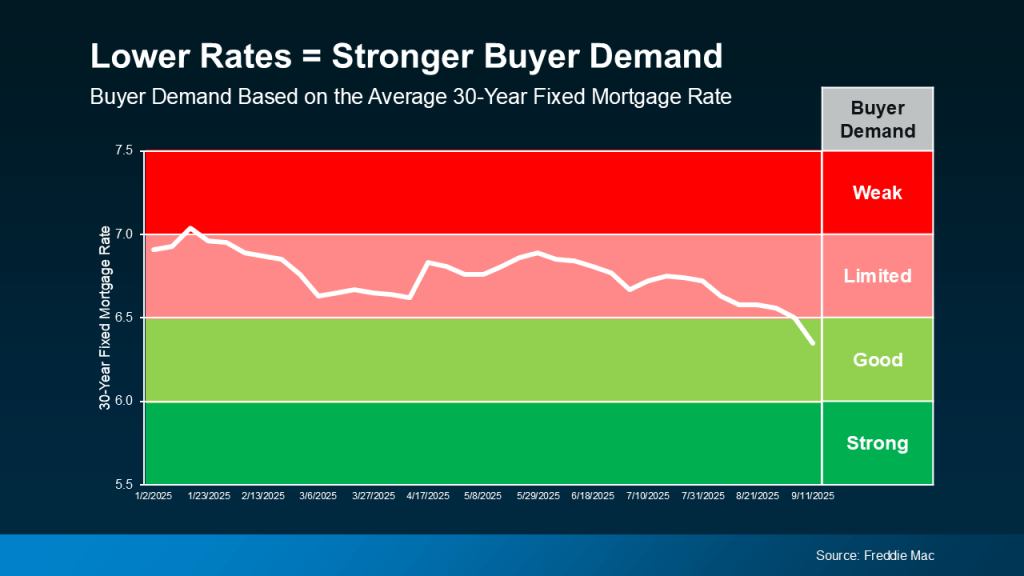
The magic number most buyers seem to be watching for is 6%. And it’s not just a psychological benchmark; it has real impact. A recent report from the National Association of Realtors (NAR) says if rates reach 6%:

  • And roughly 550,000 people would buy a home within 12 to 18 months
  • 5.5 million more households could afford the median-priced home

That’s a lot of pent-up demand just waiting for the green light. And if you look back at the graph above, you’ll see Fannie Mae thinks we’ll hit that threshold next year. That raises an important question: Does it really make sense to wait for lower rates?

Because here’s the tradeoff. If you’re waiting for 6%, you need to realize a lot of other people are too. And when rates do continue to inch down and more buyers jump into the market all at once, you could face more competition, fewer choices, and higher home prices. NAR explains it like this:

“Home buyers wishing for lower mortgage interest rates may eventually get their wish, but for now, they’ll have to decide whether it’s better to wait or jump into the market.”

Consider the unique window that exists right now:

  • Inventory is up = more choices
  • Price growth has slowed down = more realistic pricing
  • You may have more room to negotiate = you could get a better deal

These are all opportunities that will go away if rates fall and demand surges. That’s why NAR says:

“Buyers who are holding out for lower mortgage rates may be missing a key opening in the market.”

Bottom Line

Some people have told us that they are holding off on making their next move in order to see “what happens.” If that means if rates are going to drop, you have your answer. They aren’t expected to hit 6% this year.

But when rates drop, you’ll have to deal with more competition as other buyers jump back in. If you want less pressure and more negotiating power, that opportunity is already here – and it might not last for long. It all depends on what happens next in the economy.

If you’re thinking about entering the market but want to talk it through, we’re here to listen. You can find us at 508-388-1994 or msennott@todayrealestate.com. Let us know how we can help.

Mari and Hank

Nothing herein should be construed as investment advice. You should always conduct your own research and due diligence and obtain professional advice before making any investment decision.

Three Things You Risk by Pricing Too High

When selling your house, the price you choose isn’t just a number, it’s a strategy.

If you’ve been following the real estate market, you’ve no doubt noticed that there have been a lot of price changes lately. More than we’ve seen in a while.

Does that mean prices are falling? Not exactly. In many cases the seller priced their home too high to begin with.

When selling your house, the price you choose isn’t just a number, it’s a strategy.

The number of homes for sale is climbing. And that means buyers have more choices and can be more selective. If your price doesn’t line up with what else is out there, they’ll go right past it and go on to the next one.

Pricing right from the start is your best move – we can help make sure you do.

Overpricing Comes at a Cost

More sellers are finding that out the hard way. They list their house based on how things were a year ago – or based on a neighbor’s sale that happened under completely different circumstances. Maybe even what they “want.” Then, when their house doesn’t sell, they’re left with three tough choices:

  1. Drop the price: Cutting the price might help get more eyes on the house again, but it can also trigger red flags. Buyers may wonder what’s wrong with it. And that’s going to impact any offers you get after the price cut.
  2. Take it off the market: Some sellers give up on the idea of selling right now. The worst part about this is that it means putting their future plans on the back burner. That dream of more space, downsizing, or relocating? On pause.
  3. Rent it out: Others go the landlord route, but managing tenants and navigating leases isn’t always the simple fallback it seems. Renting can work, but being a landlord is often a lot more hassle than people expect.

None of those options were part of the original plan. And honestly, none of them are where you should end up if you wanted to sell. Here’s a look at how our expertise can help you avoid these headaches. Let’s use price cuts as an example.

location Makes a Difference

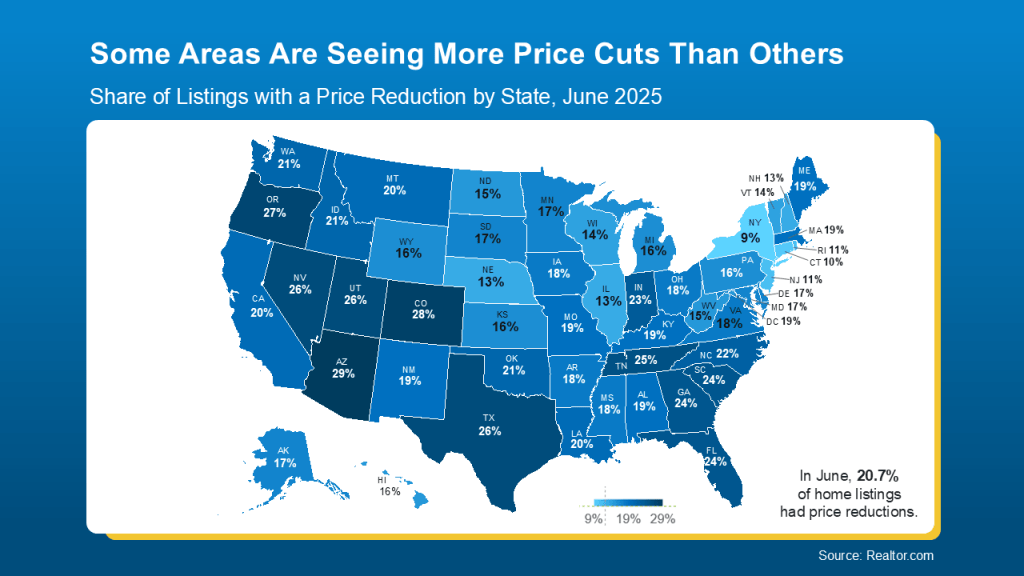
While the number of price cuts is up nationally, this map shows some parts of the country are seeing far more of them than others. It all comes down to how much inventory has grown in that area (see map below):

As Realtor.com explains:

“Regionally, price reductions in June were significantly more common in the South and West (23% of listings) than they were in the Northeast (13% of listings), reflecting the inventory divergence across these regions.”

In Massachusetts, 19% of listings had price reductions.

That means pricing isn’t one-size-fits-all. And that’s why you shouldn’t try to determine your list price on your own.

We can Help You Nail the Price

We just don’t just toss out a number or tell you what you want to hear.

As Zillow says:

Well-priced homes are more likely to sell quickly, but pricing your home to sell quickly and for maximum dollar requires strategy and knowledge of your local market. You need to have a clear-eyed view of your home in relation to the competition, and knowledge about whether you’re in a buyers or sellers market. It also helps to know what buyers in your area can afford.” 

And that’s all knowledge we have. We know the Cape Cod market, compare recent sales, and factor in your goals and buyer behavior. Based on what’s happening, sometimes the best play will be pricing right at current market value. Other times pricing a little lower actually will spark more offers and ultimately get you a better final sale price.

Bottom Line

Overpricing can lead to tough choices you never want to face. But with the right price, and the right guidance, you can skip the stress and sell with confidence. Let’s connect so you have a pricing strategy that works for today’s market and gets you where you want to go. You can always find us at 508-388-1994 or msennott@todayrealestate.com.

Mari and Hank

Nothing herein should be construed as investment advice. You should always conduct your own research and due diligence and obtain professional advice before making any investment decision.
Think No One Is Buying Right Now??

Think again.

Maybe you’ve seen headlines saying home sales are down compared to last year. You might even be thinking – is it even a good time to sell? 

Here’s the thing. There’s no denying that the pace of the market has cooled compared to the frenzy we saw just a few years ago. Cumulative days on market for 2025 is 61 as opposed to 47 one year ago. But that’s not a red flag. It’s a return to normal. And normal doesn’t mean nothing’s happening. Buyers are still out there – and homes are still selling.

Why? Because real life doesn’t pause for perfect conditions. There are always people who need to buy – and this year is no exception. Buyers who are in the middle of a big change in their lives, a new marriage, a growing family, or a new job still need to move, no matter where mortgage rates are. And they may be looking for a home just like yours.

Every Minute 8 Homes Sell

Let’s break it down using the latest sales from the National Association of Realtors (NAR). Based on the current pace, we’re on track to sell 4.03 million homes this year (not including new construction).

  • 4.03 million homes ÷ 365 days = 11,041 homes sell per day
  • 11,041 homes ÷ 24 hours = 460 homes sell per hour
  • 460 homes ÷ 60 minutes = roughly 8 homes sell every minute

That means in the time it takes to read this; another 8 homes will sell. Let that sink in. Every minute, buyers are making moves – and sellers are closing deals.

If you’ve been holding off on selling your house because you think buyers aren’t out there, let this reassure you – there are still buyers looking to buy.

On Cape Cod more than 900 single family homes have closed this year with nearly 1,100 more pending. The median sales price for the year thus far is $756,490.00. That’s 3% higher than last year.

Remember: median sales price is the midway point. There are just as many homes for sales below the median price as above.

But since the market is balancing out, selling today takes more than just putting up a sign in the yard. You’ve got to price your house right, market it well, and know how to reach the buyers who are ready to act. That’s where we come in.

We’ll help you navigate this market, position your home to stand out, and guide you through every step.

We know the market so we also can assist you in finding the right home that meets your goals.

Bottom Line

The market hasn’t stopped. Buyers are still buying. Life is still happening. And if selling your home or buying one (or both!) is part of your next chapter, you can make it happen.

Roughly 11,000 homes are selling every day. When you’re ready to make the change you need to, let’s connect at 508-388-1994 or msennott@todayrealestate.com and we’ll start working on where’s next for you.

Mari and Hank

The information contained, and the opinions expressed, in this article are not intended to be construed as investment advice. You should always conduct your own research and due diligence and obtain professional advice before making any investment decision.

Tempted to Sell Your Home Yourself?

Selling your house without an agent as a “For Sale by Owner” (FSBO) may be something you’ve considered. Everyone knows someone who knows someone who sold a home on their own and everything went “just fine.”

But did it really?

Did they leave money on the table? Agree to a concession that they didn’t need to? Spend too much on legal fees? When it was all over, how much money did they really save by not hiring a real estate professional to manage the sale??

You don’t hear much about any of that because maybe the “successful” seller doesn’t understand what they lost.

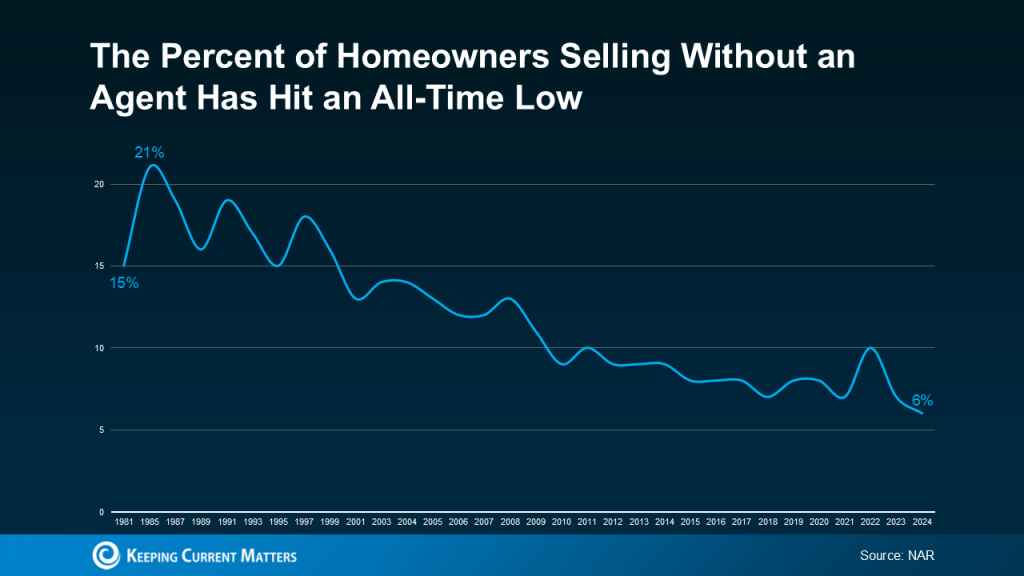
Here’s what you need to know. In today’s shifting market, more homeowners are deciding that it’s not worth the risk to go it alone.

According to the latest data from the National Association of Realtors (NAR), the number of homeowners selling without professional assistance has hit an all-time low (see graph below):

And for the small number of homeowners who do decide to sell on their own, data shows they’re still not confident they’re making a good choice.

A recent survey finds three out of every four homeowners who don’t plan to use an agent have doubts about whether that’s actually the right decision.

And here’s why. The market is changing – not in a bad way, just in a way that requires a smarter, more strategic approach. And having a professional in your corner really pays off.

Here are just two of the ways our expertise makes a difference.

1. Getting the Price Right in a Market That’s Evolving

One of the biggest hurdles when selling a house on your own is figuring out the right price. It’s not as simple as picking a price that you want, sounds good, or is what your neighbor’s home sold for a few years back – you need to hit the bullseye for where the market is right now. Without professional to help, you’re more likely to miss. As Zillow explains:

“Agents are pros when it comes to pricing properties and have their finger on the pulse of your local market. They understand current buying trends and can provide insight into how your home compares to others for sale nearby.”

Basically, we know what’s really selling, what buyers are willing to pay today, and how to position your house to sell quickly. That kind of insight can have a big impact, especially in a market that’s balancing out.

2. Handling (and Actually Understanding) the Legal Documents

There’s also a mountain of documentation when selling a house, including everything from disclosures to seller and buyer contracts. A mistake can have big legal implications. This is another area where we can help.

We’ve handled these documents countless times and know exactly what’s needed to keep everything on track, so you avoid delays. And now that buyers are including more contingencies and asking for concessions again, we can guide you step by step, making sure everything is done right and documented correctly the first time.

Selling Your House Quickly in a Shifting Market

Even though inventory has grown, homes aren’t selling at quite the same pace as they were. But you can still sell quickly if you have a proven plan to help your house stand out.

Just remember, as a homeowner you don’t have the same network or marketing tools that we do. Selling a house is more than sticking a sign in the ground and putting a posting on Facebook.

We’ve sold over 400 homes.

So, if you want the process to happen in a timely manner, let’s connect at 508-388-1994 or msennott@todayrealestate.com.

Mari and Hank