Before You Fall in Love with a House – Do This

You don’t have to be ready to buy to be ready to buy.

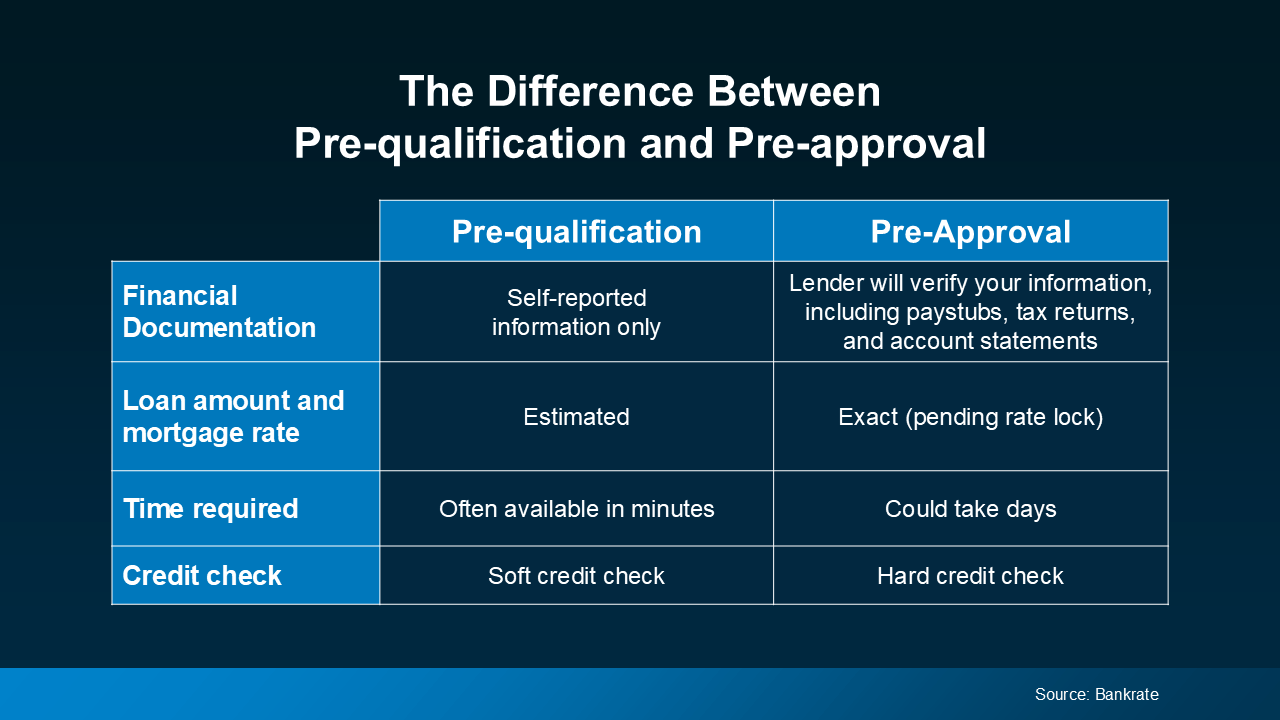
Be honest. Have you started looking at homes online or in person? If you have, it’s already past time to get pre-approved. Here’s why.

If buying a home is on your radar – even if it’s more of a someday plan than a right now plan – you don’t want to wait to find out what you can afford and what lenders are willing to loan you.

No matter what you’ve heard, pre-approval isn’t about commitment. It’s about clarity.

Here are the two big ways pre-approval sets you up for success. 

You Know Your Numbers Up Front 

During the pre-approval process, a lender will walk through your finances and tell you what you can borrow based on your income, debts, credit score, and more. Once you have that number, your search becomes a lot more focused.

With a mortgage pre-approval, you know what you can borrow, so it’s easier to figure out your ideal price point, and what you can actually afford. And that clarity is key.

Because if you just start browsing online or going to open houses just guessing at your price point, you run the risk of falling for a house that’s outside of your price range – and missing out on ones that are.

You want this number to be clearly defined before your search. Here’s why.

You Can Move Quickly When You Find the One

This is how a lot of home searches go today. You scroll through listings just to see what’s out there, and then it happens. You fall in love with something you’ve seen online.

If you’re already pre-approved? You’re probably in great shape.

But if you’re not…

Instead of being able to quickly make an offer, you have to scramble to get a lender, gather the financial documents, and then submit the necessary pre-approval paperwork first. And while you’re waiting to hear back from your lender, someone else who’s more prepared could beat you to the house. As Bankrate explains

“The best time to get a mortgage preapproval is before you start looking for a home. If you find a home you love but don’t have a preapproval in hand, you likely won’t have time to get preapproved before you need to make an offer . . .”

And that’s avoidable, with the right prep.

While you can’t control when the right home will show up, you can be ready for it. Think of it like showing up to the starting line with your shoes tied and your warm-up done – while everyone else is still looking for parking.

It’s not about rushing your timeline. It’s about removing the delay between finding the right home and being able to move on it.

One Thing You Need To Know About Pre-Approvals

Speaking of timing, pre-approvals do have an expiration date. So, be sure to ask your lender how long it’s good for. The Mortgage Reports explains:

Mortgage preapproval letters are typically valid for anywhere from 30 to 90 days. However, a preapproval can be updated and extended if the lender re-checks your information.”

Doing the right prep and knowing this information can make the whole process a lot smoother.

You don’t have to be ready to buy to be ready to buy.

Getting pre-approved doesn’t mean you’re committing to buy right now. It just means you’ve taken a step to understand your numbers. And when a home catches your attention, you’re prepped and good to go.

Bottom Line

So, ask yourself this: if your perfect home popped up tomorrow, would you be ready to make a move?

If the answer is no and you’re thinking about buying, it may be time to get pre-approved. You don’t feel behind before your search even officially kicks off.

If you don’t already have a lender, just let us know. We can connect you with several trusted professionals who have worked with many of our buyers and consistently delivered excellent service.

You can always find us at 508-388-1994 (Mari and Hank) or 781-423-8662 (Colleen).

If you have buying on your mind, let’s talk soon…

Mari, Hank, and Colleen

Nothing herein should be construed as investment advice. You should always conduct your own research and due diligence and obtain professional advice before making any investment decision.

Three Must-Do’s for Buying Your First Home

If you currently own and are getting ready to buy for the first time in years, this checklist is a good place to start.

Buying your first home is an exciting time, but it can also be a little nerve-wrecking because it’s something you’ve never done before. And trying to think of everything you need to do can feel like a lot. But here’s the key.

You don’t have to figure everything out on your own. And you don’t have to do it all at once. Just tackle it one thing at a time.

Here’s a simple list of three items you should focus on to help you get started.

1. Assemble Your Team: Don’t Do This Alone

Buying a home is a team sport. And having the right professionals by your side can make a world of difference. Here’s who you need to find: 

  • A local real estate agent. We can be your guide from the first showing to closing day. We’ll make sure you understand all the details along the way, so you feel confident in your decision.
  • A trusted lender will walk you through loan options, monthly payments, and what’s realistic for your situation. That information is something you’re going to want early on. We can recommend reputable local lenders who we work with on a regular basis.

2. Prep Your Finances: Set the Foundation First

This is what determines what you can afford, how competitive you’ll be, and how confident you’ll feel when it’s time to make an offer. Here’s how to get ready: 

  • Check your credit score. Your credit score impacts the loan options you’ll qualify for and even the mortgage rate you’ll get. Knowing this number early gives you time to work on raising your score, if its necessary.
  • Save for your down payment and closing costs. Most buyers focus on the down payment, but closing costs can sometimes matter, too. Having savings set aside for both helps you avoid last-minute stress and surprises.
  • Look into assistance programs. Many first-time buyers qualify for programs  that will give their homebuying savings a boost. This can make buying possible sooner than you expect.
  • Talk to a lender about mortgage options. Fixed-rate, adjustable-rate, FHA, VA, and conventional loans all work differently. Understanding the options helps you choose what fits your goals best.
  • Get pre-approved. A pre-approval tells you what a lender would be willing to give you for your home loan. This’ll help you figure out your price range and set you up to move fast when the right home comes along.
  • Figure out your budget. Your mortgage is just one part of homeownership. Budgeting for your utilities, home insurance, and everyday expenses and maintenance will help make sure your payment feels comfortable, not stressful.

3. Gather Your Documents: Save Time (and Stress)

When you’re officially ready to kick off the buying process, lenders are going to need to verify your income, assets, and financial history. Having these documents ready-to-go upfront can speed up the process and reduce back-and-forth. Here’s what Bankrate says you need to prep:

  • W-2s and tax documents (past 2 years). These show income stability and help lenders verify your earnings over time.
  • Recent pay stubs (generally the past 1–2 months). Pay stubs confirm your current income and employment status.
  • Bank statements (past 2–3 months). These show your savings, spending patterns, and where your down payment funds are coming from.
  • Investment account statements (past 2-3 months). If you’re using investments as part of your financial picture, lenders may ask for these as well.
  • Copy of your driver’s license. This verifies your identity and is required for loan processing.
  • Residential history (past 2 years). Lenders use this to confirm stability and background information.
  • Statements for any outstanding debts (past 2 months). Student loans, auto loans, and credit cards affect your debt-to-income ratio, so lenders will want to know about them.
  • Proof of supplemental income. Bonuses, commissions, side work, or child support may count toward your income if documented properly.

Note: the exact time frames and list of documents may vary lender to lender. This is just a general rule of thumb to help you get the ball rolling.

Bottom Line

Buying your first home doesn’t mean you have to have everything figured out. It just requires a plan.

If you currently own and are getting ready to buy for the first time in years, this checklist is a good place to start, too.

If you begin with your finances, organize your documents, and surround yourself with the right people, you’ll be in great shape when the time comes to make a move.

If you want more information on anything on this list or just need help getting started, don’t hesitate to reach out. You can always find us at 508-388-1994 (Mari and Hank) or 781-423-8662 (Colleen.)

We’re happy to help…

Mari, Hank, and Colleen

Nothing herein should be construed as investment advice. You should always conduct your own research and due diligence and obtain professional advice before making any investment decision.

Is a Myth about Credit Scores Holding You Back?

Even though a lot of people assume you need flawless credit to buy a house, that’s not necessarily the case.

Many would-be homebuyers aren’t sitting on the sidelines because they don’t want to buy. They’re sitting out because they think they can’t buy because of their credit scores.

According to a Bankrate survey, 2 out of every 5 (42%) Americans believe you need excellent credit to qualify for a mortgage. That may be why, when renters are asked why they don’t own, “my credit isn’t good enough” is often the answer.

Maybe you’re in the same boat. You look at your score, see it’s not where you want it to be or think it should be, and assume buying your first place just isn’t realistic right now.

But here’s what you need to know.

Even though a lot of people assume you need flawless credit to buy a house, that’s not necessarily the case.

You Don’t Need Perfect Credit To Buy a Home

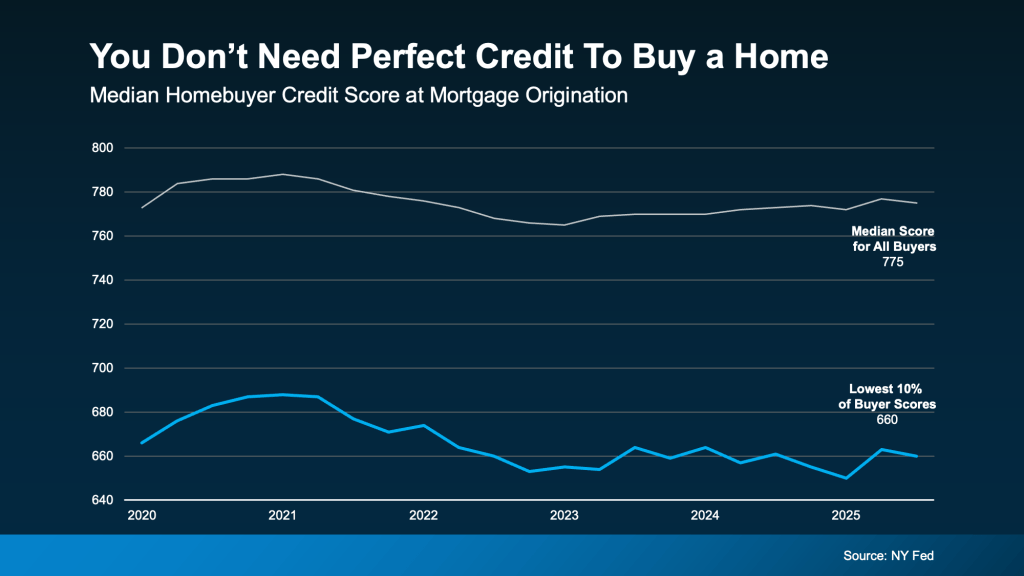
So, where’s this myth come from? Part of the confusion stems from the fact that the typical homebuyer today does have a fairly strong credit score. In fact, according to data from the NY Fed, the median credit score for all buyers is 775.

But that doesn’t mean you need a score that high to qualify.

Looking at recent homebuyers, a number were able to get a mortgage with scores below that threshold. Data shows 10% of scores were around 660. Which means some were higher than that and some were lower, but the median in that lowest 10th percentile was around that range (see graph below):

So, even if your score isn’t as high as you want, that doesn’t automatically close the door. FICO explains that there is no universal credit score you absolutely have to have when buying a home:

“While many lenders use credit scores like FICO Scores to help them make lending decisions, each lender has its own strategy, including the level of risk it finds acceptable. There is no single ‘cutoff score’ used by all lenders, and there are many additional factors that lenders may use . . .

The best thing to do is to talk to a trusted lender to see what’s possible for you. Because a portion of buyers are buying with scores in the 600s – and maybe that means you can too.

Bottom Line

Your credit score is important. But that doesn’t mean it has to be perfect.

If credit has been the reason you’ve been waiting to buy a home, it’s probably time to take another look at your options. If you want help understanding where you stand and what your next step could be, connect with a local lender. We have worked with several and can pass on their contact information. Just reach out to us at 508-388-1994 or msennott@todayrealestate.com.

You won’t know where you stand unless you start a conversation.

Mari and Hank

Nothing herein should be construed as investment advice. You should always conduct your own research and due diligence and obtain professional advice before making any investment decision.