
Are you sitting at home today wondering if your house still works for you?
With everyone at home and unable to go outside because of the weather are you realizing that it’s just too small? Or are you closing doors and shutting off heat in rooms you haven’t used in years in order to keep utility bills down as you wait out the storm?
You may have heard that as a homeowner you have a lot of equity built up in your property. But what does that really mean?
Because your equity isn’t just a number, it’s a powerful asset that can help you take your next big step in life which could mean upsizing, downsizing or maybe saying goodbye to the cold weather.
How Much Equity Does the Typical Homeowner Have?
Here’s how it works. As you pay down your loan and home prices rise through the years, the share of your home that you own free and clear grows. That’s your equity.
And according to data from the Census and ATTOM two-thirds of homeowners have a substantial amount of it today.
- 39% own their home outright without owing anything on it.
- Another 27% have at least 50% equity in their homes (see chart below):
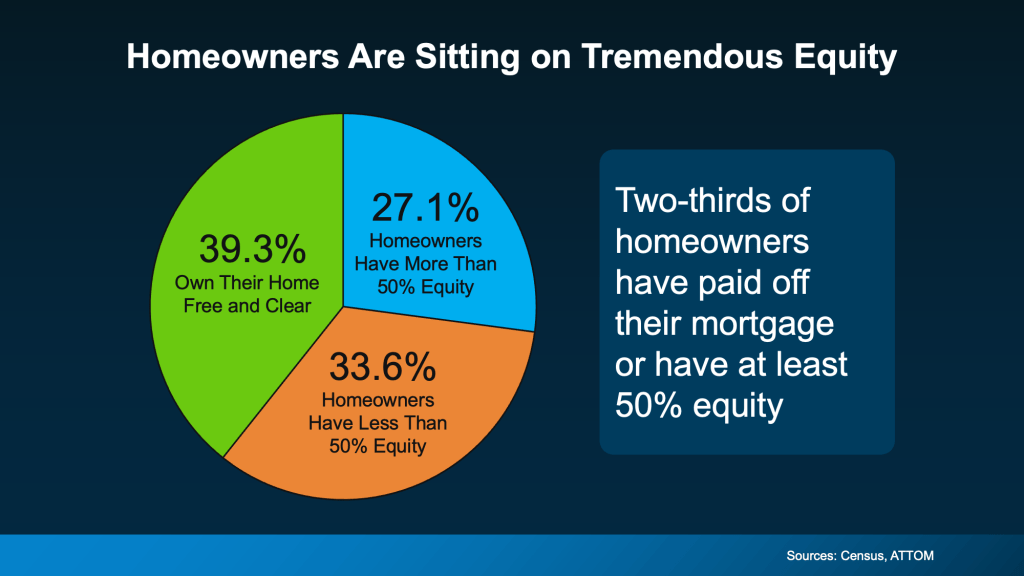
That’s a big deal. And just in case you’re wondering how that translates into real dollars, Cotality says the typical homeowner has almost $300k in equity today. That’s six figures.
And whether you have that much, even more, or a bit less, here are a few examples of how you can use it.
1. Move Into a Home That Better Fits Your Life
Your needs change over time. Maybe your home is starting to feel cramped, or maybe you have more space than you need that your adult children have moved out. Either way, you can use your equity as a down payment on a home that’s a better fit for what you need now and going forward. You may even have enough equity to buy your next house in cash
2. Upgrade Your Current Home
If you’re not ready to move just yet, you could reinvest some of your equity in your current home instead. Renovations like a kitchen refresh or updated bathrooms could add value when it’s time to sell down the line. Finishing your basement might provide your family more elbow room. Replacing windows could help with those high utility bills. Just be sure to talk to us before you tackle your project list, so you can prioritize updates that’ll give you the biggest return later on.
3. Fund a Major Life Goal
Equity can also help fund your life goals – whether it’s starting a business, saving for retirement, covering education costs, or helping out someone you love. Some homeowners are even passing down some of that wealth to help fund a loved one’s down payment on a home.
4. Avoid Foreclosure in Tough Times
While the number of home foreclosures continues to be small, if you’re struggling with payments, your equity can also be a lifeline. Many homeowners who hit financial hardships can sell their homes and walk away with money in their pockets instead of facing foreclosure. If that’s something on your mind, please talk to us about your options and how your equity can help.
Your Next Steps
If you’re interested in using your equity for one of the reasons above, here’s what to do:
- Step 1: Ask us for a personalized equity assessment on your home.
- Step 2: Meet with a financial advisor if you’re interested in using that equity.
When it comes to tapping into this resource, there are a few things you’ll want to keep in mind – like making sure you still have a good loan-to-value ratio (LTV) even if you use some of your equity.
That means, as a general rule of thumb, you want to maintain at least 20% equity in your home as a financial cushion – something many homeowners didn’t know back in the crash of 2008.
The good news is, according to the Intercontinental Exchange, most of today’s equity meets that guideline:
“As of Q4, mortgage holders have $17.3T in home equity, including $11.2T in tappable equity ‒ accessible via cash-out refinances or home equity lines while maintaining 20% equity in the property . . . ”
Bottom Line
Your home equity is one of the biggest financial assets you have. Whether you’re thinking about moving, remodeling, or working toward a big goal, it’s worth exploring your options. Reach out to us to learn more.
You can always find us at (508) 388-1994 [Mari and Hank] or (781) 423-8662 [Colleen].
What’s one goal you have that you’d go after right now, if you had the funds to do so?
Mari, Hank, and Colleen
Nothing herein should be construed as investment advice. You should always conduct your own research and due diligence and obtain professional advice before making any investment decision.





 Make Your Move with Mari